|
→ View in browser
With Veganuary not too far behind us, I’ve been wondering how food resources — and access to them — are changing. Not only what we eat, but how availability itself is being reshaped. Once, words like vegan and vegetarian belonged to a recognizable ideological space and persona. Today, people move in and out of these diets for climate reasons, for health, for cost, or simply for curiosity. Products are increasingly branded as “plant-based” rather than “vegan”, a linguistic shift that makes the category feel less oppositional and more accessible. What used to signal abstention now signals option. And so, every January, more established brands unveil plant-based versions of meals you didn’t know you needed.
Food has long felt stable — rooted in memory, routine, geography — but lately it feels as if the ground beneath it is shifting. The search for new markets goes hand in hand with changes in resources and accessibility, reshaping taste itself. In Europe, the plant-based market grew by about 5.5% in 2023, reaching €5.4 billion in sales. Lab-grown meat has received approval in a handful of countries, while farmers return to crop rotation and regenerative methods in response to the reality that a third of the world’s soils are already degraded. Progress seems to move in two directions at once: toward technology, and back toward the earth.
But these directions don’t move at the same speed. High-tech innovation captures headlines; soil changes slowly. Cultivated meat still faces major cost barriers, with growth media priced at hundreds of euros per liter. Organic farmland in Europe accounts for only about 11% of agricultural land, and organic products remain under 10% of retail sales. Interest may be widespread, but affordability and scale move more slowly. The promise of transformation travels faster than infrastructure. And it is precisely in that gap — between what is possible and what is scalable — that culture steps in.
Food is no longer simply grown or produced, it circulates through platforms, personalities, and aesthetics. Food creators scale from home kitchens to restaurants and product lines almost overnight. Trends convert niches into markets with unusual speed. High-protein claims now dominate new product launches across all food categories; making protein read less as nutrition and more as a necessity. At the same time, viral ingredients can briefly bend global supply chains. Surging international demand for matcha has pushed up wholesale prices in Japan, as aestheticised routines travel across feeds and translate into export pressure. A ceremonial tea moves at algorithmic tempo.
Seen together, these shifts reveal something less about what we eat and more about how meaning circulates. Demand now responds to narrative as much as necessity. Value can intensify within weeks. The future of food may not be a single direction at all. It may be a coexistence of speeds — soil and lab, protein claims and regenerative fields. Food is no longer just a product of nature — it’s a collaboration between biology, technology, and belief.
The question, then, isn’t which future is “right,” but how we navigate so many at once. What do we preserve, and what do we let go of? Can innovation and intuition share the same kitchen? And as we learn to feed the planet differently, what parts of the past will still sit at the table with us?
Estelle
|
Some numbers
|
59%
|
Nearly 59% of U.S. households purchased plant-based foods in 2024, even though the category still represents just 1.1% of total retail food sales.
|
|
165 companies
|
There are now 165 fermentation-focused food companies globally — turning microbes into milk proteins, fats, and flavor.
|
|
$1.7bn
|
The global edible insects market is valued at roughly $1.7 billion in 2025 and projected to grow sharply over the next decade, moving insects from novelty to emerging protein category.
|
|
Read between the lines

|
Making ‘Food Out Of Thin Air’ — Philip Maughan, Noema (2024)
An essay exploring the cultural and economic fascination with novel food technologies like air-based food and ultramodern production, inviting reflection on what we value as “food” and why radical substitution captures the imagination.
|
|
|
The Science of Shelf Appeal — Lacerta (2025)
A design-centered look at food packaging and retail aesthetics, showing how shelf presentation communicates values, desirability, and meaning long before we taste what’s inside — and how that shapes what we think we want.
|
|
|
The cowboy who got rich selling veggie burgers — Frida Garza, Grist (2026)
A narrative account tracing the unexpected commercial rise of plant-based burgers in the American food economy, revealing the interplay between entrepreneurship, consumer tastes, and the evolving politics of protein.
|
|
Food archives
Food archives collect the material memory of how we have fed ourselves — from historical packaging and recipes to preserved culinary knowledge. They reveal not only what people ate in the past, but how meaning, technology, and cultural priorities shaped those foods and the ways they were remembered, shared, and retold.
|
Old practices, new resources
Many of the most visible "new" food movements are not inventions, but redistributions. Practices rooted in necessity, locality, and embodied knowledge are re-emerging through new movements and new voices.
|
Foraging
|
Black Forager — Edible plants, field walks, and sharp ecological storytelling that reconnects wild food with history and place.
Feral Foraging — Practical plant identification and real-world gathering — less aesthetic wilderness, more hands-in-soil guidance.
Vild Mad — A digital map of Nordic wild ingredients, turning forests and coastlines into searchable food landscapes.
|
|
Fermentation
|
Cultured Guru — Fermentation explained in jars: sauerkraut, kimchi, kombucha — microbes made visible and manageable.
Fermentation Adventure — A guide to live cultures and homemade ferments, where patience becomes part of the method.
Johnny Kyunghwo — Energetic kitchen fermentations, from kimchi to pickles, filmed as ongoing experiment rather than finished product.
|
|
Bread Baking
|
King Arthur Baking Company — A platform and company empowering people of all levels to give baking a go, from baguette to pretzel buns.
The Bread Code — A software engineer explains how to bake the perfect bread at home, backed by science and without expensive tools.
Breaking Bread — A new CNN series starring actor Tony Shalhoub exploring bread around the world.
|
|
|
Enjoying NOC? Your friends, family, community and colleagues might too. Here is a link for you to share this edition with them.
Link to this edition
|
Ways to get inspired

Fork Ranger
A platform linking everyday food choices to carbon emissions and climate impact, helping people visualize and compare the environmental footprint of different meals.
|

Table Debates
An initiative bringing together diverse voices — farmers, policymakers, scientists, food producers, and citizens — to discuss food system challenges and co-create visions for equitable, sustainable futures.
|
Offrange
A project that supports regenerative agriculture and transparent supply chains by connecting producers and consumers, emphasizing the economic and ecological value of land-centred food systems.
|
|
|
Our picks
|
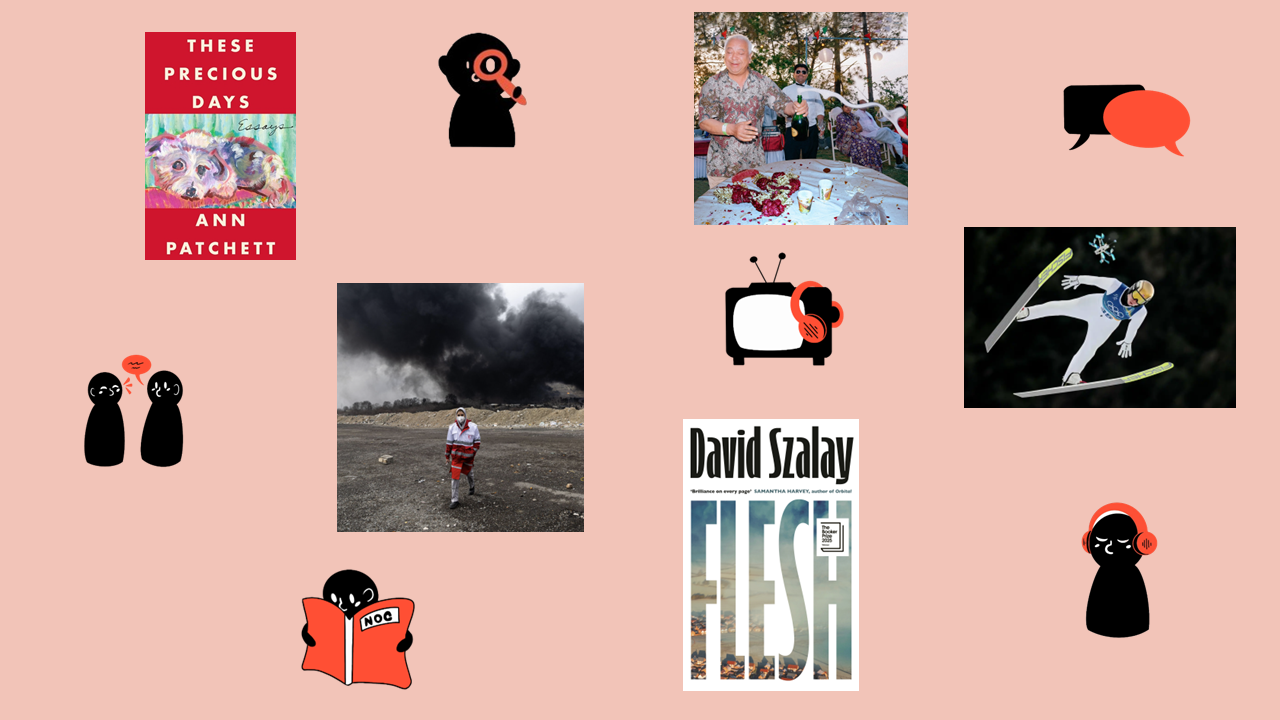
Move over, athletes. The Olympics have a new star — An article by Will Leitch for the Washington Post on the use of drones for videography at the Olympics.
These precious days — A collection of essays by Ann Patchett, sparked by an unexpected friendship with actor Tom Hank’s assistant, Sooki.
Bismillah — An album by the indie rock band Peter Cat Recording Co.
Flesh — By David Szalay, the winner of the Booker Prize in 2025. Follow the life of István, from adolescence to old age, from Hungary to London.
Inside Iran as the bombs fall — A podcast episode to hear the voices of Iranians living through the current war and insights from peace strategist Sanam Naghari-Anderlini.
|
|
|
NOC is a constant work-in-progress. We want to hear your thoughts, recommendations and ideas—reply to the newsletter via email or write to us on social media (LinkedIn or Instagram). Your input will help shape where we go next!
You can browse past editions on our website.
Was this email forwarded to you? You can register to our newsletter here.
One ask from us: to avoid our newsletter landing in your spam inbox, add our email address as a contact.
|
|